Showing posts with label line of best fit. Show all posts

Thursday, December 14, 2017

MPM1D1 - Day 68 Speedy Lines

We started with a visual pattern today:


It was interesting to see how students counted the number of watermelons in each step. It seemed as though most groups had a couple of different ways of counting which made for some interesting discussions. I think the hardest part here was generating the table of values. Once they had that, groups quickly came up with the equation and the number of watermelons in the forty-third step.

We took up the equations mastery test from yesterday and hopefully cleared up some misconceptions.

Today's main event was practicing coming up with the equation for a line of best fit. Everyone can draw a line of best fit but when I ask for the equation many students go to their tables to find the slope. When they do this they don't always choose points that are on the line. We need to work on realizing that we want to use points that are on the line to find the equation.

Today we timed to see how long it takes to assemble 5,6,7,8,9 and 10 linking cubes. This is an idea that I modified from Mary Bourassa's Speedy Squares. Rather than making squares we just connected cubes to form a line. Groups worked to collect data. Some groups needed to work on being consistent but got it sorted out pretty quickly. Then they plotted the data and worked to find an equation of the line of best fit. They then practiced using their equation. Here's the handout.

With about fifteen minutes to go we tried the mastery test on solving equations again.

It occurred to me at the end of the period that I don't take enough pictures of students working or of their work. Something to work on. Sorry about the lack of photos.

Thursday, November 30, 2017

MPM1D1 - Day 59 Knotted Ropes

The warm-up for today was this Which One Doesn't Belong:


It was a nice tie in to what we have been doing (slopes, intercepts, parallel lines) and I heard some great reasons for each one not belonging.

After the warm-up we consolidated the work that we did yesterday on parallel and perpendicular lines. 

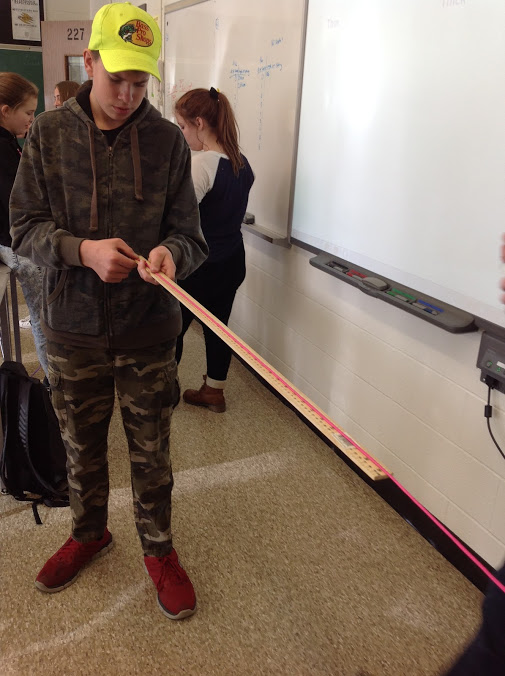
The goal for today was to have students explore the relationship between the number of knots in a rope and its length (inspired by this post). Each groups received a length of rope and a length of string. 


They were to create a table, graph and equation to represent both their rope and string, then determine how many knots were needed to make both ropes the same length (same number of knots in each rope). We only had about 30 minutes to complete the activity. I knew that students wouldn't finish but was hopeful. Most groups worked very effectively, but a couple couldn't seem to measure accurately enough. I might need some larger diameter rope that doesn't stretch so much. A number of groups found that their rope was longer after adding a knot to it.

Nobody got past the graphing stage so we'll finish up tomorrow.


Wednesday, November 22, 2017

MPM1D1 - Day 54 Finishing Up Barbie Bungee

Today we finished up Barbie Bungee. A couple of groups wanted to collect more data or double check some of their data from yesterday. Students began analyzing the data. They were creating graphs, both by hand on using Desmos. They were extrapolating using their graphs. They were coming up with the equation of their line of best fit. They were performing linear regressions in Desmos and comparing it to their findings. There was a lot more reasoning about the reasonableness of their answers than I expected. Once students had a number of rubber bands they were happy with they began writing their reports.


With about twenty minutes left we headed to the stairwell to see who could get Barbie the closest to the floor without hitting it. It was so much fun. We had one person at the bottom recording in slow motion. Some students were at the top of the stair watching, while others chose to observe from below. The closest group had Barbie touch the floor with her outstretched hand, but not touch her head. There was some debate about this should count or not. What do you think?


I haven't received a copy of the video yet but once I do I will post it.

What a great end to a great activity. I can't wait to read the write-ups.

Tuesday, November 21, 2017

MPM1D1 - Day 53 Barbie Bungee

We skipped the traditional warm-up today and got right into Barbie Bungee. Our warm-up was co-constructing the success criteria.

As students came into class they received a card (as they always do) that would assign them to a random group. After the bell went I had students gather at a white board at the back of the room. I explained that each group would receive a Barbie and they had to figure out how many rubber bands to tie onto Barbie so that she got as close to the floor without hitting it when she was dropped from the stairwell. I told them that this was an assignment and I wanted them to go to their boards and come up with a list of criteria that they thought should be included in their assignment. I felt like after the time we spent working on the success criteria  for the Pumpkin Time-Bomb assignment, students had a good sense of what should be included in an assignment.


I was not disappointed. The results were far better than they were the first time we co-created success criteria. Each group created a good sized list of useful criteria this time around. After about 10 minutes I stopped them and had them group their criteria into categories of their choosing. As it turned out most, if not all groups, created three different categories. The categories were roughly Data (needed/given/measured), Mathematics (graph, table, equation, line of best fit), Report (description of task and process used, showing your work, proper terminology, units etc.).


I brought the class together, we talked about the categories and some of the items in their categories. I told them that I would organize all of their ideas and send them a written copy via email.

I handed out the Barbies and seven rubber bands and let them go. There were lots of ideas floating around that led to some great thinking.


  • We could measure one band and multiply by seven. 
  • Should we measure them stretched or not?
  • Let's measure from the floor up.
  • Our measurements weren't very accurate (In one case adding a 10cm band only added 2cm to the distance Barbie fell).
  • Let's do three trials at each level and take an average.
  • We should each trial, then watch the video to see how far Barbie fell.


The data collection was time consuming and messy at times but in the end every group came away with a set of data they felt comfortable with. Although it was time consuming I think having students struggle through those difficulties and errors was very worthwhile.

Tomorrow they'll start to analyse their data and begin putting together their individual reports, which will be due sometime next week.