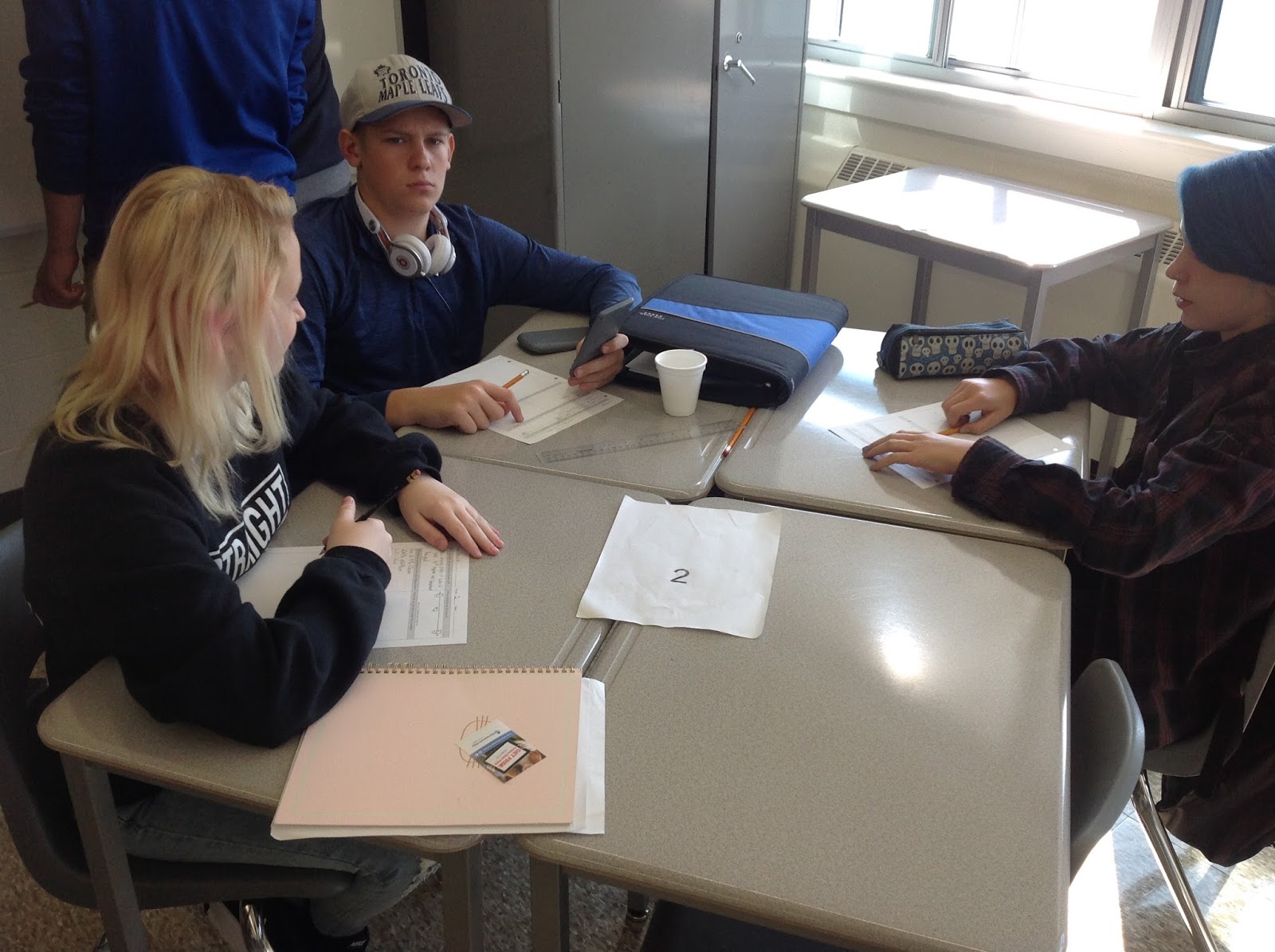
Most groups started by making a table of values. Those that didn't weren't really sure where to start and so I suggested a table. I was happy to see many groups showing the first differences (though we didn't call them that) in their tables.

I asked what was the same and what was different compared to yesterday's pattern. It was great hear things like "The constant is different" or "It's going up by the same amount". We talked a little about how these showed up in the equations.
Next we moved onto more cup stacking. The goal for today was to change how we stacked the cups and how that changed the equation and graph. I asked how many cups would be needed (stacked inside one another) to reach R's height. All groups saw that the height of the stack was changing by the lip of the cup for each additional cup. A couple of groups struggled with the initial value. They thought it should be the height of a cup rather than the body of the cup. Every group did manage to come up with an equation but struggled to solve the 2-step equation needed to find the number of cups (not surprising since we have done much equation solving yet).
Once they were done finding the number of cups needed to get to R's height they went back to their seats and plotted Height vs. Number of Cups. We talked about how the graph was different from the one they made yesterday. This led to a need for some terminology (partial vs. direct variation) so we wrote a note about graphs. The note included dependent vs. independent variables, continuous vs. discrete data, lines of best fit and interpolation vs. extrapolation. I was hoping to get into partial and direct variation and slope but we ran out of time.
I gave some homework on plotting points on the Cartesian Plane and identifying whether variables were dependent or independent.
At the end of class I had a student come to me and tell me that he was feeling lost. He said he was able to follow what his group members were saying but he wasn't sure he'd be able to come up with the numbers on his own. He told me that he did well in math last year but wasn't feeling very confident. We chatted for a bit and he agreed to come in tomorrow at lunch so we can go over a few things. I'm curious to see if his issue is related to skill or confidence.