Showing posts with label wodb. Show all posts

Sunday, December 10, 2017

MPM1D1 - Day 65 Solving Equations With Fractions

We started with this Which One Doesn't Belong:


It was great to hear all of the terminology that came out of the discussions.

After the warm-up we moved into solving equations with fractions up at the board in groups. I didn't give any instructions. I gave some equations for groups to solve and they did a great job.

Here are the questions they worked on:


I was amazed at how well the groups worked. They required little to no assistance from me. They were able to apply what they had learned about solving equations without fractions and things worked out great. It was also great to see the stronger students really working with those that struggled to bring them along. I feel that we've really developed a community of learners in the class and I'm really happy about that. One of the groups consisted of two students who pretty much refused to work with each other at the beginning of the semester. Today they worked as though they were good buddies.

Once the groups were done I brought the class together and asked what was different about the equations today. Many students said that these equations were more difficult. When I asked why they were more difficult the response was because of the fractions. We then talked about how we could eliminate the fractions by multiplying both sides of the equation by a common denominator. We did a couple so they could see how it was done then they did the first part of this handout.

Monday, October 16, 2017

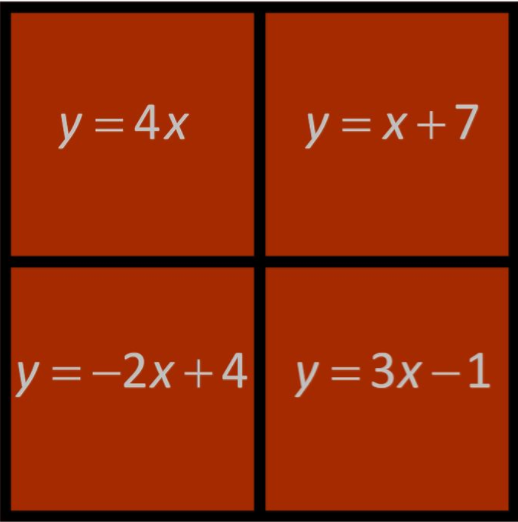
MPM1D1 - Day 28 WODB, Tables of Values & Equations of Lines

We started with this Which One Doesn't Belong:


I figured that this would be a bit of a challenge. I knew that students would be able to look at the equations and pick some characteristics out (which they did). I also knew that my students see these four equations differently than I do. When I see these equations I picture the graphs. My students can't do that yet. We've done a lot of graphing of equations but most of that graphing was with scenarios that are concrete and have some meaning. These equations are very abstract.

In any case, I put this up to see what would happen. Right away one student asked for graph paper. Others then started asking if they had to graph it. I told them that they didn't have to. Many said "Wait! What? I don't know how to graph that." I gave them a bit of time to think this one through. I helped a few students who really wanted to be able to graph. We took it up and had some great discussions. I had some superficial type answers (the first one doesn't have a number added or subtracted). I thought I would be disappointed with these types of answers but I really wasn't because each of them led to some talk (led by other students) about what those parts of the equation are, what that means about the relationship and what it means about the graph. The discussions were fantastic. Some of the students were having a hard time connecting all the pieces but it's a conversation we can revisit throughout the semester.

This seemed to be a good time to discuss how we can graph a relationship using a table of values. This was a bit of a leap for some students, which surprised me given the number of visual patterns that we've done and the number of times we've graphed those patterns. I think had I told them that each equation came from a certain pattern, and given the pattern, they would have been fine. We took a step up the ladder of abstraction and talked about how we can create a table of values and plot those point. We did this, together, for the equation in the upper left and then they worked on the one in the bottom right. Did I mention this was just the warm-up? #longestWarmUpEver?

With the warm-up behind us we could move onto connecting slopes, y-intercepts and equations of lines. As it turns out we already had some equations, tables and graphs on the board. We talked about how to find the slope and y-intercept from the graph, from the table and finally they told me how to find them from the equation. My favourite comment of the day: "You mean we can just look at the equation and get slope and y-intercept? We don't have to graph it or make a table?" I think there was some incentive to understand y=mx+b.

I gave them the first two pages of  this handout (thanks @MrHoggsClass). Once that was done I handed out some practice on creating tables of values and equations of lines.


Saturday, September 9, 2017

MPM1D1 - Day 4 Order of Operations & Pythagorean Theorem

We had an assembly today so it was a shortened period. I had thought that it might be a good day to try a visual pattern but decided against it.

Instead we started with our first Which One Doesn't Belong. I decided to use the one below only because my students have seen cards a lot this week. They see them every day to determine where they sit and they saw them when we played integer solitaire. I was curious to see if any of them would make a connection back to the game about black being positive and red being negative. It turns out nobody did.


In our discussion yesterday about multiplying and dividing integers, order of operations came up. They all seemed to know the rules so I went over them fairly quickly but we did spend a bit of time talking about exponents. I gave them a few questions to try and then we took them up.

We also went over the Pythagorean Theorem. They knew how to find the length of the hypotenuse from yesterday's work so we worked through an example of finding one of the legs. I gave them some order of operations and Pythagorean Theorem questions for homework.