Showing posts with label volume. Show all posts

Thursday, December 21, 2017

MPM1D1 - Day 74 Test Review

We started today by looking at these two objects that were printed yesterday.


The goal was to consolidate some of yesterday's work and to reinforce one of yesterday's big ideas. Because of the work my students had done with their pentominoes, they knew that each pentomino was made up of five cubes. The cubes on the small pentominoes were 0.5 cm in all direction and the cubes on the large one were 1 cm in all directions. So, I asked how many times bigger the volume of the larger one was compared to the smaller. I received a couple of answers of 2 (which I expected), an answer of 4 (with the justification that that's what they found yesterday) and an answer of 8. I held the figures up and asked if anyone thought it would only take two of the little ones to fit into the bigger one. Strictly by intuition everyone knew that 2 couldn't be the answer. One student offered up an explanation of doubling in more than one dimension. At this point we jumped into a bit of algebra and looked at an expression for the volume of a cube that was x units long and compared that expression to one for a cube that had a length of 2x.

The large figure in the picture is a model of an original that is twice the size, in all dimensions. I asked how many of the little ones would fit in the giant one.


There was some discussion about 16 vs. 64, but eventually we settled on 64 (supported with some algebra). Once the relationship for volume was squared away we quickly touched on the relationship for surface area.

It was a good, fun discussion that I think made a lot of sense because of the manipulatives on hand, that were made by the students.

After the warm-up we wrote a mastery test on equations of lines then students continued working on the review for their test tomorrow.

Tuesday, December 19, 2017

MPM1D1 - Day 72 Surface Area, Volume & 3D Printing

I had seven students away yesterday so I spent some time at the beginning of the period recapping what we did yesterday. Once the recap was done we moved right into some volume and surface area.

My own kids have a pentomino based game called Katamino. It's a fun game that really stretches your spatial reasoning skills.


I thought it would be fun to make this game the basis for an assignment. If you don't have the game you could always modify the assignment to work with any pentominoes or even have students build their own figures using linking cubes.

The gist of the lesson is that students get a pentonmino and calculate its surface area and volume. Then they create a scale diagram of a pentomino that is half the size (in all dimensions) of their original pentomino. They calculate the surface area and volume of their model and make note of the relationship between the original and the half-sized model.

They were given the length of a spool of filament (in metres), the diameter of the filament (in millimetres) and the cost of the spool and they needed to determine the cost of their pentomino. Once they had done all of that they designed their pentomino in TinkerCAD. The designing was pretty simple and didn't take long at all. Once their design was complete they were able to print on the 3D printer.

This was meant to be a bit of a fun lesson but for whatever reason many students didn't seem to be into it. I had students working in pairs which is not something we normally do. They also weren't working at the board. Some students spent a lot of time fidgeting with the pentomino (I thought fidget spinners were so last year?), others watched as their partner did the work. One group took 30 minutes just to get their measurements, despite repeated calls to get going. I think next time I need to get groups to do their work at the whiteboards and maybe I need to be explicit about how they could split up their work. Maybe groups of three would have been better than pairs. I'll have to rethink the logistics of this one.

Having said that I had two groups print today. They did a great job and were pretty excited about the result. I had one more group that finished everything except for the printing at lunch. They will print first thing tomorrow. We will finish up tomorrow. I'm looking forward to trying this again to see how it goes.

Here's a description of the task. This task could also be used in an MFM2P class. I've also modified the task to fit the MBF3C course. You can find that here. Here is a link to a quick introduction to TinkerCAD.

Friday, November 17, 2017

MPM1D1 - Day 51 Optimizing Volume and Surface Area

We started with these problems:

I gave the problems orally, one at a time and groups made their way through them. It was great to watch them work. For groups that made mistakes, it was often enough for me to say "Are you sure?" for them to think a bit about what they did and find their mistakes.

We then moved onto today's work.


This problem was closely related to yesterday's Dandy Candies only this time the side lengths didn't need to be integer values. Most groups easily made the connection to yesterday's work and quickly came up with a solution. One of the groups was really struggling so I spent some time walking them through it. 

Then we moved onto these problems:


Theses problems seemed to be at just the right level. Students seemed to be in flow for the entire period. When groups would get stuck I'd ask a question or provided a hint and off they'd go. 

The last problem I gave dealt with a cylinder rather than a rectangular prism.


A couple of groups didn't get this far today, but those that did made some great headway. A couple of groups struggled with what the cylindrical equivalent to a cube would be. I asked how they would approach the problem if the top and bottom were rectangles rather than squares. That was enough to get them going. One of the groups, on their own, actually drew a cylinder inside a cube. It was a thing of beauty. I wish I'd taken a picture of it.

We were out of time so I gave a couple of rectangular prism questions to practice for homework. We'll pick up with the cylinders again on Monday and consolidate all of the optimization.

The period flew by today. Students were right into the work. It was challenging but not so much so that they couldn't overcome the challenges. What a great period.


Thursday, November 16, 2017

MPM1D1 - Day 50 Dandy Candies

We started by revisiting this type of problem:


I was curious to see how much of this work that we did a while ago they would remember. Some groups had it figured out right away. Others tried making a table which was great to see. They started with a pen that was 25 by 50 then increased (and decreased) the dimensions by 10. Which meant that they missed the optimal solution. We talked about the properties of the rectangle that seemed to give the largest area and what they noticed about it compared to the others. They quickly realized that their rectangle needed to be a square.

Before we moved onto the main event for the day we consolidated the work that we did on the distributive property yesterday. I also gave a couple of questions for them to try.

The main event for the day was Dandy Candies. I asked what they noticed and what they wondered. There were lots of good observations and a few good questions. The most common thing they wondered about was what question I was going to ask them.

We had some good discussion about volume and surface area and they had some practice calculating surface areas. Some went immediately for the formula at which point we had a discussion about what surface area actually means. No formulas were needed after that.

We finished up the class with a mastery test on collecting like terms, multiplying and dividing monomials and the distributive property.


Wednesday, October 25, 2017

MPM1D1 - Day 35 Quadratic Pattern & More Volume

Before we started today we talked about the definition of a prism. It was interesting to hear what students thought the definition was. Eventually we settled on a definition (that came from one of the students). We then talked about how we could find the volume of any prism.

We branched out a bit today and tried this visual pattern:


Groups began right away and created a table immediately. They found the first differences and realized that the pattern was not linear. Some groups showed that the second differences were the same. Others noticed it but didn't include a column for the second differences. Once groups realized that the pattern wasn't linear, they didn't know how to proceed. They realized that finding the slope wasn't an option. One group did find the y-intercept. After giving some time to struggle I stopped the class and told them that they needed to find another method. I told them that they should look at how the length and width grow from one step to the next. This was enough to get the groups to come up with an expression for both the length and width. They knew that to find the number of helmets they would need to multiply the length by the width but they struggled with how to multiply two algebraic expressions. That makes sense given that we haven't really done that yet. As a class we put the pieces together and came up with a possible solution.

Without saying, the warm-up took quite some time but I think it was time well spent. Once we were done we went back to the Big Nickel. We looked at the question of what happens to the volume if you double the height. We then explored, as a class, what happens if you double the width as well. What if we double all three dimensions? It seemed to make sense to them. I was hoping to get to the rest of the extensions of the nickel task but I also wanted to compare the volume of a cone to a cylinder. I held up the cylinder and cone and asked how many cones would fit into the cylinder (the areas of the bases are the same).


After taking some guesses I filled the cone with water then dumped it into the cylinder. I asked if anyone wanted to change their guess and a few students did. I added another one and asked if anyone wanted to change their guess. As I dumped the third one in many students were convinced that it wouldn't all fit but sure enough it did. We talked about how this relates to the formula. It seemed like lots of light bulbs went on at that point. I gave them a couple of pages to practice (here and here) and the period was over.

MPM1D1 - Day 34 The Big Nickel

We started with two volume questions as a warm-up. I wanted to see how groups did with questions that didn't have any diagrams.


Overall, they did quite well. All groups found the volume of the cone and the sphere. A couple of groups forgot to divide the volume of the sphere by two by as I asked them to explain what they did, they all got it straightened out.

I was expecting most of the groups to get tripped up with the slant height in Problem 2 but only about half did. Again, a bit of prodding on my part led to students realizing that they needed to use the Pythagorean Theorem to find the height.

We moved onto the Big Nickel. We started by finding the volume of the big nickel. I was surprised at how long this took. Many students were desparate for a formula for the volume of a dodecagon. When I told them they didn't need it, many seemed quite stumped. After pondering the problem and comparing to their list of formulas many realized that they could break the nickle into twelve triangular prisms. One group chose square based pyramids at first but when I asked if they could show me a square based pyramid they realized that they were on the wrong track.

Once the groups calculated the volume of the big nickel they found the volume of an actual nickel and determined how many nickels would fit inside the big nickel. Some students moved on from there to find out how much that would cost. We were pretty much out of time so I gave them this handout to practice. It has a bit of surface area on it, which we haven't done, but I think they will be able to figure it out.

I was a little shocked at how long things seemed to take today. I'm not sure why things took so long. I was a little under the weather so I wonder if my lack of energy led to a lack of energy for my students. We'll see how it goes tomorrow.

Through the work that we did today I have come to the conclusion that many students don't seem to know the definition of a prism. I'll have to address this tomorrow.

Monday, October 23, 2017

MPM1D1 - Day 33 Volume & Hot Coffee

The focus today was on volume. I started with this brilliant.org problem.


What I really like about this problem is that there are no numbers. I sent groups to work on it at the board. Some groups struggled at first not knowing how to go about the problem without any numbers. One group just wanted to give a verbal explanation. Another group explained exactly what they had to do and told me they couldn't start because they didn't have any numbers. I asked if it mattered what 'the numbers' were. They realized it didn't and carried on. Some groups quickly realized that it didn't matter what the dimensions were so they picked a number. For whatever reason four seemed to be a common dimension for the length of the cube. When I asked groups why they chose four, some said because there were four balls across in image C. Another group said that they thought four might be easy to work with since the perimeter of a square of length four was the same as the area of a square of length four. I'm not sure what this had to do with this problem, but I was happy to hear someone recalling a discussion we had as a class earlier in the semester. I'm guessing that some groups had a peek at the work of others and used their numbers (though nobody gave that as a reason).

This problem took a long time to get through, partly because of the lack of numbers and possibly partly because it was a Monday. Some groups had a hard time focusing. Eventually all groups were working effectively and came up with a solution.

Next we moved onto Hot Coffee. I had students complete the first part of the problem solving framework that we use on their own (state the problem, give an estimate, what do you know, what do you need). I asked what information they needed and gave it to them then I sent them up to the boards to do the work in groups. They started finding the volume (in cubic feet), then converted to gallons, then used some information about the flow rate to determine how long the process would take. The problem was good in that it involved some volume, some proportional reasoning and also dealt with rates. I often forget to do Act 3 of these problems. I tend to have faith in the work students have done and I'm happy with that. What I forget is how much pride students get from seeing that their answer was correct. I showed Act 3 and there were some pretty happy faces.

Once they finished at the board I sent them to their seats to get everything on paper so I can see how they're doing. I then collected their work so that I can provide some feedback.

I was hoping at this point to do the Big Nickel but we only had about ten minutes left so I handed out a page of volume questions they could practice. We'll save the Big Nickel for tomorrow.

Monday, September 18, 2017

MPM1D1 - Day 10 Finishing Up The Giant Toonie

The warm-up for today was this Would You Rather problem:


I had students work in groups but at their desks rather than the whiteboards since their work from Friday was still up on the board. It was much harder to see what was going on when students were seated compared to what they would do at the board.

One student said he'd prefer the 40' pool because it was longer. He seemed happy to stop their so I asked if he could find out how much water in the pools. Some groups converted the feet to yards, others the yards to feet. One student wanted to use the formula for surface area but fortunately his group convinced him that he was calculating the wrong thing. All the groups had some good success with this problem.

We then went on to find out how many toonies would fit in the giant toonie. This problem had multiple steps to it and many students struggled with those steps. This reinforced the importance of being organized and methodical. All groups were able to find the volume of the actual coin, after asking for a formula. Determining the volume of the giant coin proved to be a challenge. They had a hard time figuring out that they needed to find the scale factor, then use the scale factor to find the thickness of  the giant toonie. There were a few unit conversion errors but all of the groups knew that they needed to divide the volume of the big coin by the volume of the little coin. Of course this assumes that the coin can be packed in (melted down?) without any space for air.

This was a fun problem to watch groups struggle through. They really had to think about what the problem was asking and come up with a plan. Some students were quite frustrated by it, but hopefully this process will get easier for them as we do it more often.

Once we were done we did a quick not on calculating area and perimeter and I gave them some questions to practice.

Saturday, September 16, 2017

MPM1D1 - Day 9 Fractions and Measurement

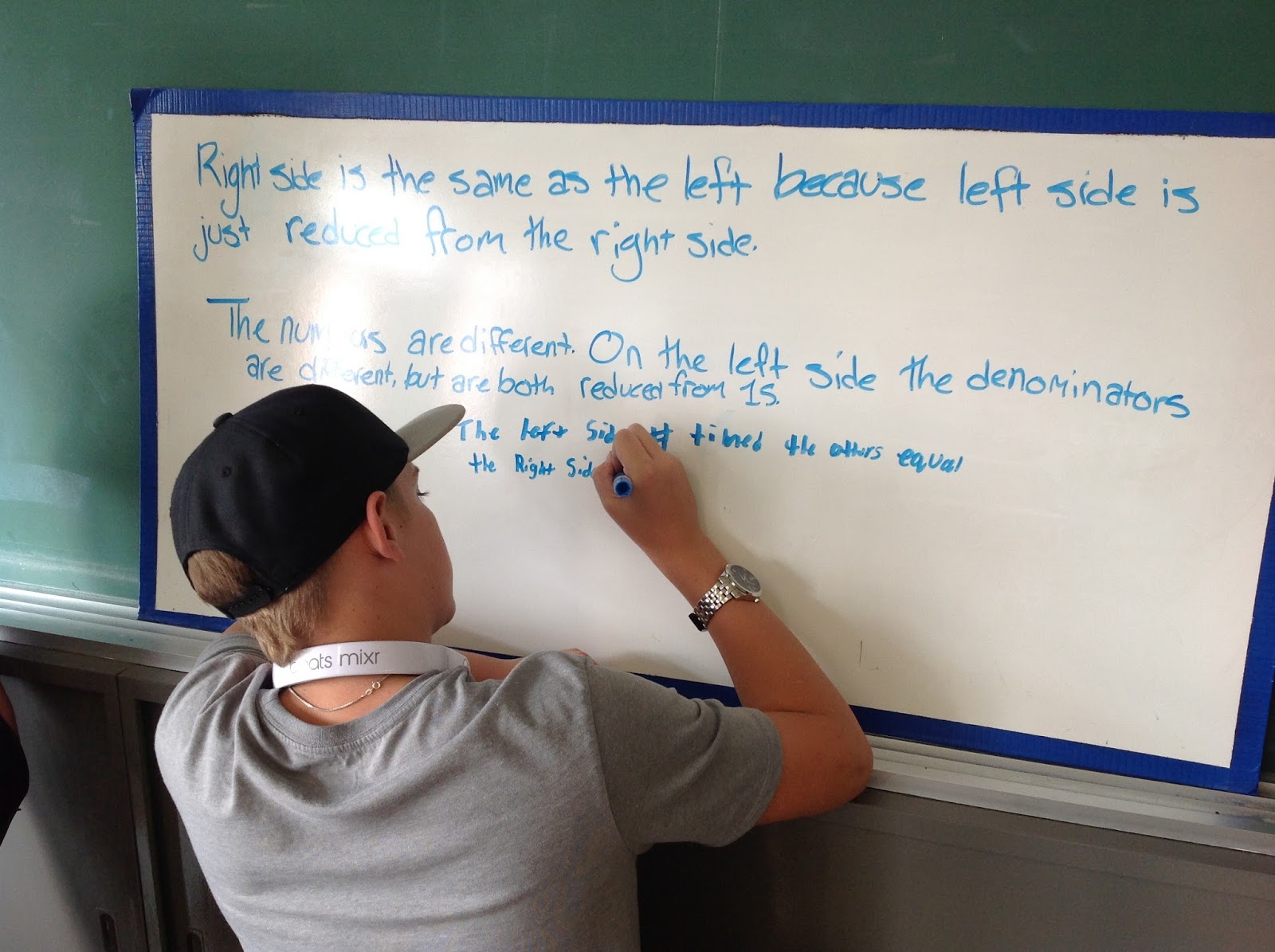
I came across this problem last night so I thought I try it in class since we had been discussing fractions.


Some groups were quick to recognize that the fractions on both sides were equivalent, others performed the calculations and didn't really notice anything that was the same. I asked how they could compare the fractions. That was enough to get them to thing about reducing their answers. Some groups chose to scale the smaller numbers up. All the groups seemed to do just fine with the division, which was a bonus.


We moved on to Jon Orr's R2D2. Which didn't take long to solve. It was interesting to see that the half of the class on the west of the room did it one way (divide the width of the bulletin borad by the width of the sticky note to find how many would be needed, do the same for the width then multiply) and the groups on the east of the room all found the area of the board and the area of a sticky and divided them. Perhaps knowledge was moving around the room but not crossing the centre line.


Next up we were going to look Kyle Pearce's Big Nickel. I showed the video and asked how many of them had been to Sudbury and how many had seen the Big Nickel. I was surprised to see that only two of my students had seen the Nickel.  I then asked how many of them had been to Campbellford to see the Giant Toonie. It was about half the class so I decided to proceed with the toonie.
I showed a picture of the toonie. 


They asked some questions such as "How big is it?" and as a class we decided to find out how many real toonies would fit inside. I gave them the following information about the giant toonie and we headed to Wikipedia for details about the actual toonie.


I told them to assume that the giant toonie was built to scale and then set them loose. We haven't talked about measurement so I was keen to see where this would go. One group started by figuring how many toonies would fit across the diameter of the monument, another calculated the circumference of both. One group wanted to work on volume but couldn't remember how to find the volume of a cylinder so we talked about how to find the volume of a prism and I let them sort things out from there. We ran out of time so we'll have to pick up where we left off Monday.