
We had a guest in our class today. I had a meeting with a teacher from another school this morning and he decided to stick around and check out my class. It's always nice to have visitors. Teaching is often done in isolation. It's nice when we can get together in a classroom and reflect afterwards. We need to do more of this. At some point I need to make time to get #observeMe going.
We started the day with this visual pattern:
I asked students to find an equation that represented the surface area for step n. I handed out the linking cubes and students went to the boards. Some began building the model, others quickly made a table (of values, not an actual table made of cubes). Many just made a table for the number of cubes. Others tried using a formula, without giving it much thought. Still others tried to reason their way through only to fall back on 'the formula'. When groups got stuck with their chosen formula I asked what surface area was (we haven't really talked much about it in class). Everyone I asked was able to tell me it was the area of all the faces. I asked them to forget about the formula and find the surface area using the cubes they had in their hands and off they went. One group wanted to find the surface area of the rectangular prism then subtract the exposed surface of the cube that was missing. I asked what happens when they take out the middle cube and they realized that they would have to add in the surface area of centre. An neat approach.
Some groups finished the task quickly while others took a long time to get there, but did manage eventually. Once they were done I had them work on these problems at the board. There were lots of great discussions (especially about the Pythagorean Theorem). Today seemed to be one of those days that things just flowed smoothly. I guess having two adults in the room can do that.
With fifteen minutes to go we did a mastery test on finding the equation of a line and I handed out some practice questions for students to work on individually.
Showing posts with label visual patterns. Show all posts
Showing posts with label visual patterns. Show all posts
Thursday, November 2, 2017


Saturday, October 21, 2017
MPM1D1 - Day 32 Not So Visual Patterns & Success Criteria
We began the day with a couple of patterns, but this time without the visual element. These came from @MrHoggsClass and they provided some great discussions. Thanks Mr. Hogg. I sent groups to the board and just let them go.

Most groups started this one by creating a table, then filling in the missing values. With the missing values in place they were able to determine the rate. A couple of groups figured out how much they were off by if they multiplied the rate by the step number. This was their y-intercept. A couple of groups worked back to step zero to find the y-intercept. I was very pleased with the conversations and how well groups were able to attack this slightly more abstract problem.
Next we moved onto this one.

The idea with this one is that filling in the gaps in the table is tedious. Some students were able to find a solution by inspection, which was cool. I pushed them to be specific about how they arrived at their answer and to explain in a way their group could understand. Most groups made a table again. Some were able to find the slope from the table, others struggled a bit but with a bit of guidance were able to make sense of finding the slope. It was nice to see some groups getting help from other grous. Groups found the y-intercept the same way they did previously.


Most groups started this one by creating a table, then filling in the missing values. With the missing values in place they were able to determine the rate. A couple of groups figured out how much they were off by if they multiplied the rate by the step number. This was their y-intercept. A couple of groups worked back to step zero to find the y-intercept. I was very pleased with the conversations and how well groups were able to attack this slightly more abstract problem.
Next we moved onto this one.


For this final pattern I wanted to make it more difficult to find the y-intercept. I was hoping it would be too tedious for students to work back to step zero. I was hopeful that students might start looking for a tool (an equation) to help them. As it turns out not a single group wrote down an equation. Most solved the equation mentally. They took one of the step numbers, multiplied it by the slope then figured out how much they were off by. This number had to be the y-intercept. They checked their equation with the other point and it all worked out. I have mixed feelings about this approach. On the one hand the rigid, rule following math teacher side of me would love to see students substituting a point and the slope into the equation of a line and then solving for the y-intercept. On the other hand I was so excited to see students using the tools that they have at their disposal to solve the problem. They clearly understand the process they used and they own it. More and more I'm thinking this is more important than simply following some abstract procedure that they don't really understand yet.
The best part about this warm-up was that students who have been struggling seem to be getting the ideas. The girl who's convinced she is going to fail the class was contributing to the group discussions. In fact, I would say she led her group today. When I asked her to explain one of her group's answers she did so very well. When I prodded the group to explain in more detail she was the one who stepped up and dug deeper. When she finished explaining I had a huge smile on my face. I was so proud of her. She too had a smile on her face. I think her confidence may be starting to improve.
Once the warm-up was finished I handed out the Bicycle Assignment. I shared the success criteria that groups created yesterday plus some of the criteria that I thought should be there. I really don't know what I'm doing with this but here is the criteria that I shared. I explained the assignment and went over the success criteria and still many students seemed to have no idea what to do. Somehow some of them had no idea that they needed to write a report. If you have any suggestions about how I could improve my use of success criteria, I'd love to hear them. They had the rest of the period to work on the assignment. I will collect them on Monday.
I had a number of students who hadn't submitted the last assignment so I kept them in at lunch today to get it done. I kept them for up to 30 minutes. If they weren't finished they were to do the rest at home and hand it in on Monday.
Tuesday, October 10, 2017
MPM1D1 Day 24 Water Line & Distance-Time Graphs
Today we started our second cycle. For the warm-up we looked at a non-linear pattern for the first time (Visual Pattern #1).

The goal was to find out how many square were in the forty-third step and to come up with a general equation for the number of squares in the nth step. It was interesting to see the approach given that we've done so many linear patterns. Most groups created a table of values and found the pattern. They realized that the values weren't going up by the same amount. They were so accustomed to finding the first difference (though we haven't called it that yet), using that as the multiplier in the equation then finding the initial value. Some groups abandoned the idea of using the differences and instead starting looking at how the pattern actually grows from step to step (using the dimensions of the squares). Most groups that did this had no trouble finding an equation. For those that finished early I asked them to determine a rule for the number of toothpicks in each step. For the groups that didn't look at the dimension of the squares, things started to get difficult. They knew that they needed to add two more to what they added in the previous step but they couldn't figure out a way to do that in an equation. We'll do a few more of the quadratic patterns and I'm sure they will get better at them.
Once the warm-up was complete I meant to talk about distance-time graphs with motion sensors but I forgot. Instead I moved right into Water Line.

It's a great activity that allows students to graph the height of water in a glass over time. Immediate feedback is built right in as students click the play button to see if their graph matches the real life situation. The activity couldn't have gone any better. Students were working hard and some expressed how much fun they were having. Imagine, having fun in a math class! The best part seemed to be making their own glasses and trying to create a graph for their classmates' glasses.
After the Water Line activity we moved onto discussing distance-time graphs. What does it look like when you move towards a sensor, away from it, at a constant rate, speeding up, slowing down, etc. Then they practiced with this handout.
The goal was to find out how many square were in the forty-third step and to come up with a general equation for the number of squares in the nth step. It was interesting to see the approach given that we've done so many linear patterns. Most groups created a table of values and found the pattern. They realized that the values weren't going up by the same amount. They were so accustomed to finding the first difference (though we haven't called it that yet), using that as the multiplier in the equation then finding the initial value. Some groups abandoned the idea of using the differences and instead starting looking at how the pattern actually grows from step to step (using the dimensions of the squares). Most groups that did this had no trouble finding an equation. For those that finished early I asked them to determine a rule for the number of toothpicks in each step. For the groups that didn't look at the dimension of the squares, things started to get difficult. They knew that they needed to add two more to what they added in the previous step but they couldn't figure out a way to do that in an equation. We'll do a few more of the quadratic patterns and I'm sure they will get better at them.
Once the warm-up was complete I meant to talk about distance-time graphs with motion sensors but I forgot. Instead I moved right into Water Line.

It's a great activity that allows students to graph the height of water in a glass over time. Immediate feedback is built right in as students click the play button to see if their graph matches the real life situation. The activity couldn't have gone any better. Students were working hard and some expressed how much fun they were having. Imagine, having fun in a math class! The best part seemed to be making their own glasses and trying to create a graph for their classmates' glasses.
After the Water Line activity we moved onto discussing distance-time graphs. What does it look like when you move towards a sensor, away from it, at a constant rate, speeding up, slowing down, etc. Then they practiced with this handout.
Tuesday, September 19, 2017
MPM1D1 - Day 11 Fractions
We started with this visual pattern:

I asked them to find three rules for the pattern: the number of squares, the perimeter and the area. All groups were very quick to find the rate, most using a table and looking at the first differences even though we haven't talked about them yet. Most groups determined that they needed to multiply the rate by the step number but the answer was off so they adjusted, adding the appropriate amount. I love how much of this they're figuring out on their own.
For groups that finished early I asked them how things would change if we said that each square was 2 unit by 2 units. Their first reaction was that they just needed to double their previous answer. I asked them to prove it to me and they soon discovered that the area of the new pattern was actually four times the area of the original. Such great thinking by a great group of students.
The other day one of my students asked why the rule for dividing fractions worked. I was so happy to hear this. We didn't have time to get into that day so we had a look today.
I started with this visual, then moved into looking at dividing with a common denominator.

 Clearly the picture above wasn't going to cut it so we split things up a little differently.
 From here it was easy to see that the green would fit into the red once (the green rectangles would fit over 8 of the red) leaving one rectangle. So we would need 1 out the 8 green ones. The solution then was that the green fit into the red once plus an eighth. I think many students appreciated the visual nature of this approach. However, when I asked them to try it some of them just wanted to use 'the rule'. We talked a little about how you could do this without drawing a picture. You could find a common denominator then divide the numerators by each other and do the same for the denominators. I love this approach.
Next we talked about adding and subtracting fractions, again starting visually, then becoming more abstract. We were running out of time so I had to forgo doing a problem today. I gave them the last 8 minutes to practice operations with fractions.
One of the students asked today if we were going to be doing any textbook work this year. Since we don't have any books for this course my reply was no. He seemed happy, which seemed odd given that the homework I give is the kind of work you find in a textbook. The boy sitting beside him was the boy that approached me last week saying he wasn't sure what was going on. He said that he really liked all the group work, problem solving and working at the board.
It seems that my daily routine in this class, generally, consists of a warm up, a problem and some skill work. I really like the balance but it's tight to fit it all in everyday. It would be perfect if our classes were 20 minutes longer!

I asked them to find three rules for the pattern: the number of squares, the perimeter and the area. All groups were very quick to find the rate, most using a table and looking at the first differences even though we haven't talked about them yet. Most groups determined that they needed to multiply the rate by the step number but the answer was off so they adjusted, adding the appropriate amount. I love how much of this they're figuring out on their own.
For groups that finished early I asked them how things would change if we said that each square was 2 unit by 2 units. Their first reaction was that they just needed to double their previous answer. I asked them to prove it to me and they soon discovered that the area of the new pattern was actually four times the area of the original. Such great thinking by a great group of students.
The other day one of my students asked why the rule for dividing fractions worked. I was so happy to hear this. We didn't have time to get into that day so we had a look today.
I started with this visual, then moved into looking at dividing with a common denominator.


Next we talked about adding and subtracting fractions, again starting visually, then becoming more abstract. We were running out of time so I had to forgo doing a problem today. I gave them the last 8 minutes to practice operations with fractions.
One of the students asked today if we were going to be doing any textbook work this year. Since we don't have any books for this course my reply was no. He seemed happy, which seemed odd given that the homework I give is the kind of work you find in a textbook. The boy sitting beside him was the boy that approached me last week saying he wasn't sure what was going on. He said that he really liked all the group work, problem solving and working at the board.
It seems that my daily routine in this class, generally, consists of a warm up, a problem and some skill work. I really like the balance but it's tight to fit it all in everyday. It would be perfect if our classes were 20 minutes longer!
Wednesday, September 13, 2017
MPM1D1 - Day 7 Mastery Test, Variation & Slope
I've never done three Visual Patterns in one week, but they seemed to tie in nicely with what we were doing this week. A couple of days ago we did this one:
 Then yesterday we did this one:


Today we did this one:
All groups found the equation and the number of squares in the forty-third step easily. I wanted to show this one because we talking about direct and partial variation. We talked about how many squares the 0th step would have. We discussed what the graphs of the three patterns would look like (number of squares vs. step number) and connected an initial value of 0 to direct variations. We also talked about what was the same in all four tables and all four graphs. Somebody mentioned that the values in all the tables were going up by the same amount. Almost all groups had created a column for the first differences, even though we've never talked about it. Somebody else realized that the graphs would be going up at the same angle. We took a few minutes to get some information about direct and partial variations along with some information about slope into their notes.
I was happy to get through this when I did. Today was picture day and shortly after I finished about half a dozen students had to leave and get their photos taken.
The rest of the class did a mastery test on integers. Our department uses mastery tests to get at key skills in a course. They are short ten mark quizzes that focus on very specific but important skills. The idea is that we write the mastery test in class. The teacher marks them then hands them back (usually the next day) and go over any trouble spots. We rewrite a similar mastery test which get marked again. After the second attempt students can rewrite as many times as they want (outside of class time) until they get a mark that they are happy with. In this way the assessment is formative until the student decides it should be summative.
We finished up the mastery test and I handed out a set of data and asked them to create a scatter plot. They had to choose which variables were dependent and independent, create a scale, draw a line of best fit and list the characteristics of the graph (discrete/continuous, partial/direct, positive/negative slope).
Monday, September 11, 2017
MPM1D1 - Day 5 Cup Stacking
We did our first visual pattern today. I started with this one:

I told them that the images represent the first three steps in a pattern then asked if they could find the number of squares in the forty third step. I also asked if they could they find a rule or equation to represent the number of squares in any step (the nth step). Normally I ask for an equation and I think that is often intimidating at first. This time I focused on the rule, which we could then be turned into an equation. They worked at the problem in groups at board. They did a great job. We spent a bit of time talking about what makes an equation.

Then we moved on to Cup Stacking. I held up a styrofoam cup and asked what they noticed and what they wondered. There were some great observations but they were fairly quiet when I asked what they wondered. So I posed the question "How many cups would be needed to make a stack to my height?". This led to a discussion about how the cups were going to be stacked. Normally when I do this activity I tell the class that I want the cups stacked inside of one another. The class really wanted to stack the cups one on top of the other as shown below, so we started there. I figured we could do it both ways and discuss direct vs. partial variations.
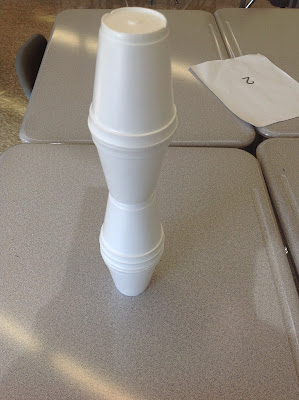
Most groups came up with a solution pretty quickly. Once they finished I asked if they could come up with an equation that related the number of cups to the height of the stack. I had a few blank looks and reminded them of the visual pattern we did at the beginning of the class. That was enough to get them going.

We had a bit time left so they created graphs showing the height of a stack of cups vs. the number of cups. Tomorrow we'll see how stacking the cups inside one another compares.

I told them that the images represent the first three steps in a pattern then asked if they could find the number of squares in the forty third step. I also asked if they could they find a rule or equation to represent the number of squares in any step (the nth step). Normally I ask for an equation and I think that is often intimidating at first. This time I focused on the rule, which we could then be turned into an equation. They worked at the problem in groups at board. They did a great job. We spent a bit of time talking about what makes an equation.

Then we moved on to Cup Stacking. I held up a styrofoam cup and asked what they noticed and what they wondered. There were some great observations but they were fairly quiet when I asked what they wondered. So I posed the question "How many cups would be needed to make a stack to my height?". This led to a discussion about how the cups were going to be stacked. Normally when I do this activity I tell the class that I want the cups stacked inside of one another. The class really wanted to stack the cups one on top of the other as shown below, so we started there. I figured we could do it both ways and discuss direct vs. partial variations.

Most groups came up with a solution pretty quickly. Once they finished I asked if they could come up with an equation that related the number of cups to the height of the stack. I had a few blank looks and reminded them of the visual pattern we did at the beginning of the class. That was enough to get them going.
We had a bit time left so they created graphs showing the height of a stack of cups vs. the number of cups. Tomorrow we'll see how stacking the cups inside one another compares.
Subscribe to:
Posts (Atom)

