Showing posts with label pythagorean theorem. Show all posts

Saturday, September 9, 2017

MPM1D1 - Day 4 Order of Operations & Pythagorean Theorem

We had an assembly today so it was a shortened period. I had thought that it might be a good day to try a visual pattern but decided against it.

Instead we started with our first Which One Doesn't Belong. I decided to use the one below only because my students have seen cards a lot this week. They see them every day to determine where they sit and they saw them when we played integer solitaire. I was curious to see if any of them would make a connection back to the game about black being positive and red being negative. It turns out nobody did.


In our discussion yesterday about multiplying and dividing integers, order of operations came up. They all seemed to know the rules so I went over them fairly quickly but we did spend a bit of time talking about exponents. I gave them a few questions to try and then we took them up.

We also went over the Pythagorean Theorem. They knew how to find the length of the hypotenuse from yesterday's work so we worked through an example of finding one of the legs. I gave them some order of operations and Pythagorean Theorem questions for homework.

Thursday, September 7, 2017

MPM1D1 - Day 3 Multiplying & Dividing Integer

For the warm up today I decided to get groups of three at the whiteboards explaining and justifying the rules for multiplying and dividing integers. They all knew the rules for multiplying integers but few could explain why they worked. I asked different groups what it means to multiply two positive numbers. They explained. I then asked what it means to multiply a positive by a negative and let them sort that out. Overall, groups did quite well until they got to a negative by a negative. One group described this as being the opposite of a positive times a negative. This would have been a good time to get into the distributive property but I didn't. I was worried about losing too many students. We'll come back to that idea later. We looked at the patterns in the left column on the board below, then the one on the right. It seemed to make sense to them and the idea of looking for patterns will come in handy later.


 We wrote a quick note about multiplying and dividing integers then got back to the work we started yesterday.

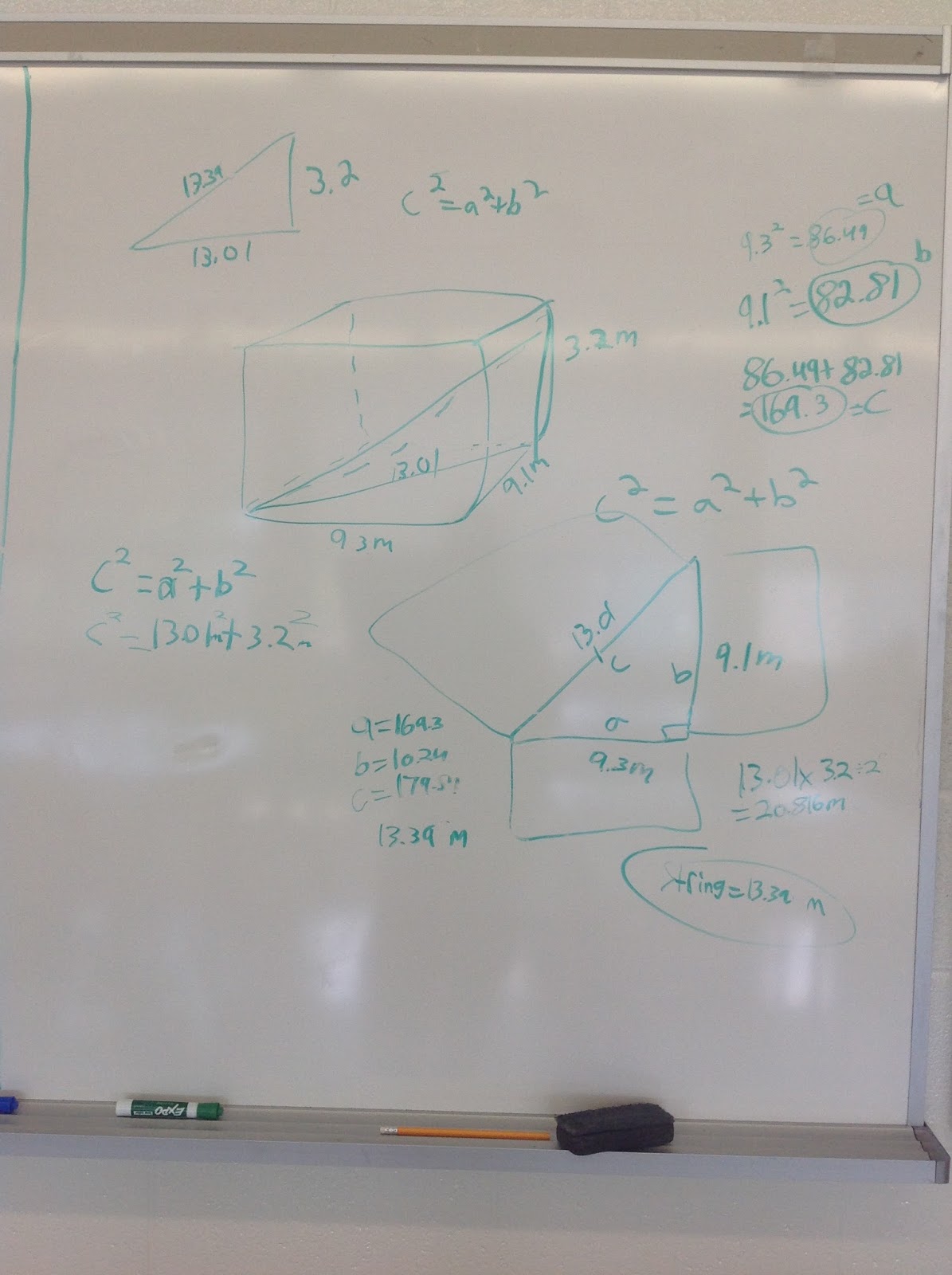
All groups were quick to start. Many groups were asking for details about the Pythagorean Theorem. I gave them enough to get started and let them work. Some made mistakes like forgetting to take the square root when finding the hypotenuse but realized that their answer didn't make sense. We talked about the step they missed. It didn't take long for every group to come up with an answer.


There were some great discussions, lots of reasoning and a sense of accomplishment at the end. We ran out of time for me to show the answer but most groups felt confident in their work. I'll show Act 3 tomorrow.


I gave them a page of multiplying and dividing integers as homework.

Wednesday, September 6, 2017

MPM1D1 - Day 2 Integer Solitaire & Corner to Corner

Today we started with Integer Solitaire. The idea is that students work in pairs (I know, it's not very solitary but it allows me to hear the thinking that's going on). As a pair they draw 18 cards from a deck of cards and try to use fourteen of them to fill in the grid below so that each equation is true. The black cards are positive and the red cards are negative.


Some groups struggled with getting starting but once they got going most were doing great. The nice thing about this activity is that there's a ton of trial and error, which means a ton of practice with adding and subtracting integers.

At one point I overheard "A negative and a negative make a positive." This seemed like a good time to discuss what adding a negative and subtracting a negative would mean. The student who made the comment realized his error as soon as I stopped the class but I thought others would benefit from the conversation so we continued on. Some groups were quicker than others so they got to play again.

After a bit of practice we moved on to Corner to Corner. We watched the video and I asked what they noticed and what they wondered. There was a good response for the noticing. Not so much for the wondering. We'll work on it.

When I start with problem solving I like to use a problem solving framework. I really like Robert Kaplinsky's layout so I handed it out and we started filling it in together.We'll do it together the first couple of times, then they can do it on their own and eventually, hopefully, they won't need the framework anymore.  Once they had all the information they needed  I put them into random groups of 3 and sent them to the board to work.

It was interesting to watch. We aren't working on any particular unit now so I saw some interesting approaches. Some groups calculated volume, others talked about finding surface area. I asked a few questions about whether volume or surface area would be helpful. I asked them to remind me what they were looking for then let them try to sort things out.

 Some groups recognized that there were right triangles involved and made reference to the Pythagorean Theorem. I heard "I don't remember the Py...whatever theorem."

We were quickly running out of time so I handed out a page with some homework questions for adding and subtracting integers and the bell went.

Tomorrow we'll get back in our groups and continue trying to find the length of the string.