Saturday, October 8, 2011

The Frustration of Learning


Recently I needed to replace the shingles on my roof. I decided to go with a steel roof instead of shingles, figuring I could do the work and save on the labour costs. I had been told by many people that putting up steel was easy and it didn't take long. This confirmed my original thought and I ordered the materials.

Now I should mention that I'm much more comfortable, and competent at, pounding a keyboard to move bits than pounding in nails with a hammer. I began by stripping the old shingles, fixing the bad spots in the roof and strapping it. This process alone had taken a lot longer than what most people said it should take to do the entire roof. I was feeling a little discouraged but I was determined to do the work properly and later discovered that most of the people I had spoken with had much simpler roofs than mine.

As I worked I learned a lot about roofing and a lot about myself. I think my best learning came from making mistakes. Doesn't all learning happen from making mistakes? I would make a mistake and then get really frustrated about it. This didn't help much since as I became frustrated I was more likely to make more mistakes. I recognized that many of my students likely get stuck in this cycle. Most of my frustration came from the fact that I was being slowed down. I just wanted to get the job done. I'm guessing that students are often in the same boat. They don't really care about the learning they just want to get the job, work, assignment, etc. done. After a while I realized that my frustration was counter productive. I decided that it would be much more productive to view my mistakes as learning opportunities. This small shift in mindset changed my entire outlook. No longer was this a project that had to be completed in a hurry. It was a project that I was going to do right and one that I could take pride in.

I think that frustration is an important part of learning. I need to let my students know that, and I need to work to ensure that they know it's a natural part of learning. I need to encourage them to work past the frustration to get to the reward side. I have a feeling that if they can get to the reward side once, getting there again will be easier.

Tuesday, September 20, 2011

No Office Day

Last week the principal and two vice-principals at my school decided to participate in 'No Office Day'. The idea behind the day is that administrators decide to spend the day in classrooms rather than in their offices. Our administrative team modified the day a little so that they could each spend a period in some classes. I was really excited to see this happening. I think that too often administrators get caught up in the paperwork, emails and dealing with the problem students and as a result don't have the time to see some of the great things going on around the school.

It was great to see the principals in a classroom chatting with students, asking questions about the work or life in general. It allowed the students to see that the principals are more than just school figure heads. It showed that they cared about the work in the classroom. It reminded me of Angela Maiers' TED Talk titled You Matter. By spending some time in the classroom the principals showed that all students mattered to them.

At the end of the day I thanked each of the principals for stopping by and informed them that the students really enjoyed the visit. All three of them said that they enjoyed the day and were keen to do it again. I hope it becomes part of their regular routine.

Monday, May 30, 2011

Do It Yourself Document Camera

A couple of weeks ago I wanted to share information with my class from a textbook that we don't use. I didn't want to photocopy and I thought why not try to use a document camera. Our school only has one document camera and given my organizational strategy, it was the night before I needed it. I hoped that the teachers who normally used the camera were not using it the next day but I started thinking about a plan B just in case. I thought if the document camera were in use I could set up a webcam and point it at the book and have the image appear on the screen. It turns out that the document camera was not in use so I didn't need to worry about plan B.

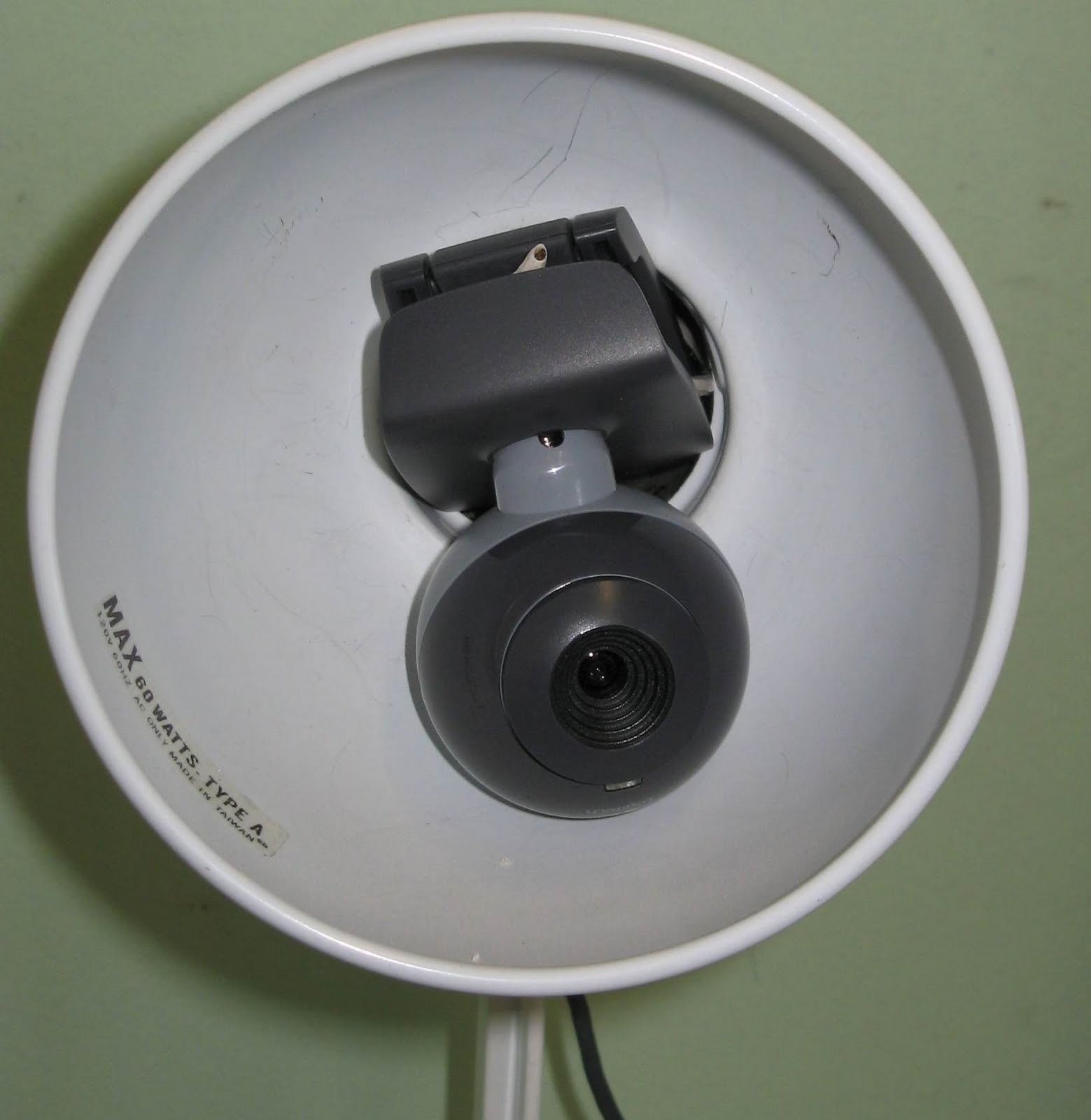
I still wanted to pursue plan B in case I ever needed a document camera again. So a week ago I took a webcam and an old lamp and put them together to form an inexpensive document camera.

Here's a rundown of how I did it.

I started with a lamp that was adjustable so that positioning could be flexible.


From there remove the nut holding in the guts of the light so that you can remove them, as shown in the picture below.  You'll have to detach the socket from the wire. This can be done by loosening the two screws holding the wires in place.


 Trim the wires. I didn't remove the wire entirely since I wanted to use it to tie the camera in place.


Now that the wires are loose you need to ensure that the lamp can't be plugged in, otherwise you could be in for a bit of a shock. You can either cut the wire somewhere, or snip off the prongs. I was unsure as to how long to make the wire so I cut off the prongs. Failure to prevent the lamp from being plugged in could result in serious harm or death. Consider the safety of those around you.


Use a rotary tool to cut out a hole large enough to fit the webcam cable through. Put on some safety goggles while doing this. It's not worth losing an eye over a webcam. You may want to file off any rough edges since the cable for the webcam will be passing through here.


Pass the cable for the webcam through the hole and use the lamp wires to tie the camera on. Pull everything nice and tight so that it doesn't move around. I found that the wire for my lamp held everything in place. You may have to tie the wire to the stand if the camera moves around too much.  I thought about finding a way to permanently attach the camera into the lamp, but I'm not finding it necessary. Perhaps there's some way to glue plastic to metal? If you have any good ideas feel free to share them.


Once the camera was setup it was a question of finding software that would allow me to display the video. The software that comes with the webcam can work but it often won't allow you to show the video full screen. So here are a couple of options. On a Mac try the QuickTime Player (File->New Movie Recoding then make it full screen). I tried iChat first but soon realized that iChat always gives a mirror image. Not so good for text. For Windows try FSCamView. It's a very simple program that takes the input from your camera and displays it using the entire screen. The quality of your video may very depending on the quality of your camera. An HD webcam may be worth the extra expense ($50 vs. $25).

Lighting may also be an issue. If so you may wish to consider an LED light. You can get some that plug into the USB port of your computer like this one or this one, or battery operated units, or even a solar powered light.

As I was searching for software solutions I came across a post where someone used an overhead projector (OHP) as the stand. I'll have to dig around the school for an old OHP that doesn't work and try it out. On second thought, I bet nobody would notice if I used the OHP that collects dust in my room.

I really enjoyed this little DIY project. The most exciting part for me was saving a ton of money by doing a little bit of work. It may finally be time to build the wiimote interactive white board.

Saturday, May 21, 2011

Open Doors vs. Closed Doors

The other day I had the opportunity to work on a project with a colleague. We spent the morning working in the library at the school. We finished up the project a couple of minutes before lunch and as I headed back to my office I noticed that every classroom door I passed was closed. There was nothing special happening at the school that day, no particular reason the doors seemed to be closed. As I noticed this I wondered if most teachers in the school regularly teach with their doors closed. Then I began to wonder what, if anything, teaching with your door open or closed says about you as teacher? I starting to think this could be a could statistics project. Have students wander the halls daily, tallying the number of open doors vs. closed doors then have students perform so statistical analysis to see if there are any types of relationships between when doors are open versus when they are closed.

I personally teach with my door open. I do it for two reasons. The first is that I enjoy the flow of fresh air that results in having the door open. When I teach with my door closed it feels as though the air in the room becomes stale. I'm not sure if there is in fact any difference in the air quality but that's how it feels.

The second reason I teach with my door open is that I want my class to be an inviting place. I want teachers, administrators and even students to feel as though they can stop in at any time. I want teachers and administrators to stop by to see what we're up to or to share an interesting story or lesson. I want students to feel that they can stop by for extra help or to share their math struggles and successes. It's exciting when a senior student comes by for extra help or wants to share how well they did on a test or assignment when I'm teaching a junior class.

Do you, generally, teach with your door open or closed? How come?

Wednesday, May 4, 2011

Angry Parabolas

As a way of connecting quadratic functions to something my students would  be familiar with I decided that we should play a game. Not just any game. I wanted to focus on one of the most popular games available for mobile devices. So I hooked my phone up to a projector and fired up Angry Birds. Most, if not all, of my students were familiar with the game and couldn't believe that we were playing it in math. I heard comments such as "Are we really going to play this?", "Is this a joke?", "What's the catch?", "You're going to link this to math aren't you?".  If nothing else they were interested in what the link to math was.

I had a couple of students come up and try the game. Once they had a chance to play I gave it a try and fired the bird high into the air so that it made a beautiful arch. I didn't hit a single obstacle and my students thought I was completely incompetent at the game. They sincerely offered suggestions about how I could improve. Eventually they realized that I had no intentions of hitting anything. I explained that the interesting part about the game is that it leaves behind a nice trail showing where the bird had been.


I took a screen shot and fired it up on the computer. We labelled the parabola and discussed some terminology. I didn't feel the need to write out any definitions. They seemed to get the ideas. It was funny to hear students helping each other by referring to the game in their explanations.

The game provided a good introduction to the unit and I wondered how I could take it further. My first thought was how cool would it be to have students write a simplified version of the game? They would learn the math, a whole ton of problem solving and some programming.  I wasn't prepared to do this since I thought it would take up too much time. I may however consider using Sam Shah's technique of modifying a program in the future. Perhaps I could write the program and they could modify it so that it worked properly.

My second thought was to have students determine the equation that modelled the path of the bird. I created a Geogebra file with the image as the background and a grid laid on top of the image. I had students determine the equation at their seats first, then I had a student come up to board and move the sliders around to reveal the equation.You can find a link to the Geogebra file here.

I'd like to find a good way of determining the equation of the function that will allow the bird to hit a certain location and use this information to improve game play. I can see some technical challenges here. I'll have to think about this for next time.


Sorry, the GeoGebra Applet could not be started. Please make sure that Java 1.4.2 (or later) is installed and active in your browser (Click here to install Java now)

Sunday, April 17, 2011

What If Math Were an Elective?

Dan Meyer made a very simple statement on Twitter that really had me thinking. His statement was:
If I ask myself this question before bed, I don't sleep: "What if math were an elective?"
 It turns out I was unable to sleep as well. The question had my mind going in many directions. The first of which was how would this change the teaching of math? My first reaction is that there would be a lot fewer students taking math. Currently in Ontario students are required to take 3 math courses. Many of them don't like math and won't take a minute more than they need to. My thinking was that the teaching would need to change to engage more students. We would have to show them how useful and exciting math can be. Get them to crave more. How do we do this? By providing them with engaging problems that they can relate to, which is easier said than done. It's a lot of work but it's something to work towards.

The other questions I had were: how would this affect students? Would they have enough basic mathematical knowledge to get through life? What effect, if any, would it have on their problem solving skills? How would this affect society as a whole? How do I as a math teacher ensure that I'm making a difference?

Unfortunately, I have a lot of questions and very few answers. I'm not discouraged by this since it's questions like these that allow us to continually improve. Perhaps we should all teach our courses as though they were electives. My guess is that students would get more out of them. I think I've just set a new goal for myself: teach as though my classes are electives.

What questions do you have? Do you have any suggestions for making math more meaningful?

Thursday, April 7, 2011

Setting Personal Learning Goals

One of the big things across the province right now is learning goals. A learning goal is what the students are expected to accomplish by the end of the class. The goal is explicit and is written in student friendly language. It should be posted somewhere at the beginning of the class and left visible throughout the class so that students can monitor how well they are meeting the goal throughout the period. This isn't anything new, the process has simply been formalized and reiterated.

Just as we have learning goals for students I think it only makes sense for teachers to have learning goals. These should be goals that are set periodically to help a teacher improve his or her learning. The learning could be in any area. Examples might include wanting to improve group work, learning a new method of presenting a lesson, learning a new technology, connecting with other teachers more regularly or anything else.  These goals can help teachers guide their learning just as they do for students. I don't think it's necessary for a teacher to have a learning goal every day but it may be useful to set one for a week, a month, a semester or even a year depending on what the goal is and how it is to be achieved.

My goal at the beginning of the school year was to improve my presentation skills. I have presented to the staff at the school numerous times and each time I did I felt like the presentations became more effective. After each presentation I wanted to present again. I was hooked. I decided that I wanted to present at a number of conferences so that I could refine my skills in this area. My goal wasn't to improve my methods of delivering my classroom lessons, but I think I may have improved there as well.

I submitted proposals to present at two conferences early in the school year. The first was a virtual unconference. meaning that I was presenting virtually to an audience from around the globe. The biggest challenge here was trying to figure out how to present without really getting a read on the audience. The audience was small and the presentation was alright. After the presentation I reflected on how I could improve and looked forward to the next presentation.

My second presentation was at the ECOO conference in November. This is the premier educational technology conference in the province. One of the first things I thought of after my proposal was accepted is 'what am I doing presenting at this conference? What could I possibly offer these very savvy teachers?'. As the presentation drew nearer I realized that I was likely doing some things in my class that at least some of the participants were not aware of.  Once the presentation was complete I wished that I could have another chance since there were a few things that I wanted to tweak right away. I reflected and made note of the things to improve.

The next two presentations were somewhat unexpected but since I was looking for opportunities I followed up by submitting proposals. One of the proposals was for the Eastern Ontario Staff Development Network. I presented two sessions on mobile learning. The room (although small) was full and we had to turn people away. The presentation went extremely well. I felt like I had finally mastered presenting. The feedback I received was very positive. I even had teachers asking where they could find the presentation since they couldn't attend. 

My final presentation came at the request of an assistant superintendent who had visited my class and liked how I was using technology to engage my students. She asked if I could present to the district principals on 21st Century Learning. I decided what better way to show what I was doing in class than to bring along some students. The presentation was only 30 minutes but in that time we were able to show some of the tools that could be used and gave participants an opportunity to try some of them. For me the best part of the presentation was the student involvement. It was so much more powerful for the students to show what they had learned and for them to show the principals how to use the technology than to simply have me speaking. We all received a nice letter from the assistant superintendent expressing how well received the presentation was. This letter made us realize just how valuable the knowledge that each of us possess can be to others. There was some talk at the end of the session about presenting to school staff or even students. The students I had brought along with me were so excited about this possibility.

The presentations have been great learning experiences. I'm happy with my progress towards my goal. Unfortunately, I don't think it's a goal that I can ever check off any sort of list. There's always room for improvement. If you want to get excited about teaching and learning make sure that you see both sides. Be a part of both teaching and learning.