Wednesday, September 13, 2017

MPM1D1 - Day 7 Mastery Test, Variation & Slope

I've never done three Visual Patterns in one week, but they seemed to tie in nicely with what we were doing this week. A couple of days ago we did this one:

Then yesterday we did this one:
Today we did this one:

All groups found the equation and the number of squares in the forty-third step easily. I wanted to show this one because we talking about direct and partial variation. We talked about how many squares the 0th step would have. We discussed what the graphs of the three patterns would look like (number of squares vs. step number) and connected an initial value of 0 to direct variations. We also talked about what was the same in all four tables and all four graphs. Somebody mentioned that the values in all the tables were going up by the same amount. Almost all groups had created a column for the first differences, even though we've never talked about it. Somebody else realized that the graphs would be going up at the same angle. We took a few minutes to get some information about direct and partial variations along with some information about slope into their notes.

I was happy to get through this when I did. Today was picture day and shortly after I finished about half a dozen students had to leave and get their photos taken.

The rest of the class did a mastery test on integers. Our department uses mastery tests to get at key skills in a course. They are short ten mark quizzes that focus on very specific but important skills. The idea is that we write the mastery test in class. The teacher marks them then hands them back (usually the next day) and go over any trouble spots. We rewrite a similar mastery test which get marked again. After the second attempt students can rewrite as many times as they want (outside of class time) until they get a mark that they are happy with. In this way the assessment is formative until the student decides it should be summative.

We finished up the mastery test and I handed out a set of data and asked them to create a scatter plot. They had to choose which variables were dependent and independent, create a scale, draw a line of best fit and list the characteristics of the graph (discrete/continuous, partial/direct, positive/negative slope).


Tuesday, September 12, 2017

MPM1D1 - Day 6 More Cup Stacking

I modified the Visual Pattern we did yesterday slightly to see how quickly my students would be able to spot the differences and come up with a solution. Again I asked them to find the forty-third step and a rule/equation to find the number of squares in any step. Here's what we started with:
Most groups started by making a table of values. Those that didn't weren't really sure where to start and so I suggested a table. I was happy to see many groups showing the first differences (though we didn't call them that) in their tables.


 I asked what was the same and what was different compared to yesterday's pattern. It was great hear things like "The constant is different" or "It's going up by the same amount". We talked a little about how these showed up in the equations.

Next we moved onto more cup stacking. The goal for today was to change how we stacked the cups and how that changed the equation and graph. I asked how many cups would be needed (stacked inside one another) to reach R's height. All groups saw that the height of the stack was changing by the lip of the cup for each additional cup. A couple of groups struggled with the initial value. They thought it should be the height of a cup rather than the body of the cup. Every group did manage to come up with an equation but struggled to solve the 2-step equation needed to find the number of cups (not surprising since we have done much equation solving yet).
Once they were done finding the number of cups needed to get to R's height they went back to their seats and plotted Height vs. Number of Cups. We talked about how the graph was different from the one they made yesterday. This led to a need for some terminology (partial vs. direct variation) so we wrote a note about graphs. The note included dependent vs. independent variables, continuous vs. discrete data, lines of best fit and interpolation vs. extrapolation. I was hoping to get into partial and direct variation and slope but we ran out of time.

I gave some homework on plotting points on the Cartesian Plane and identifying whether variables were dependent or independent.

At the end of class I had a student come to me and tell me that he was feeling lost. He said he was able to follow what his group members were saying but he wasn't sure he'd be able to come up with the numbers on his own. He told me that he did well in math last year but wasn't feeling very confident. We chatted for a bit and he agreed to come in tomorrow at lunch so we can go over a few things. I'm curious to see if his issue is related to skill or confidence.

Monday, September 11, 2017

MPM1D1 - Day 5 Cup Stacking

We did our first visual pattern today. I started with this one:


I told them that the images represent the first three steps in a pattern then asked if they could find the number of squares in the forty third step. I also asked if they could they find a rule or equation to represent the number of squares in any step (the nth step). Normally I ask for an equation and I think that is often intimidating at first. This time I focused on the rule, which we could then be turned into an equation. They worked at the problem in groups at board. They did a great job. We spent a bit of time talking about what makes an equation.


Then we moved on to Cup Stacking. I held up a styrofoam cup and asked what they noticed and what they wondered. There were some great observations but they were fairly quiet when I asked what they wondered. So I posed the question "How many cups would be needed to make a stack to my height?". This led to a discussion about how the cups were going to be stacked. Normally when I do this activity I tell the class that I want the cups stacked inside of one another. The class really wanted to stack the cups one on top of the other as shown below, so we started there. I figured we could do it both ways and discuss direct vs. partial variations.


Most groups came up with a solution pretty quickly. Once they finished I asked if they could come up with an equation that related the number of cups to the height of the stack. I had a few blank looks and reminded them of the visual pattern we did at the beginning of the class. That was enough to get them going.


We had a bit time left so they created graphs showing the height of a stack of cups vs. the number of cups. Tomorrow we'll see how stacking the cups inside one another compares.

Saturday, September 9, 2017

MPM1D1 - Day 4 Order of Operations & Pythagorean Theorem

We had an assembly today so it was a shortened period. I had thought that it might be a good day to try a visual pattern but decided against it.

Instead we started with our first Which One Doesn't Belong. I decided to use the one below only because my students have seen cards a lot this week. They see them every day to determine where they sit and they saw them when we played integer solitaire. I was curious to see if any of them would make a connection back to the game about black being positive and red being negative. It turns out nobody did.


In our discussion yesterday about multiplying and dividing integers, order of operations came up. They all seemed to know the rules so I went over them fairly quickly but we did spend a bit of time talking about exponents. I gave them a few questions to try and then we took them up.

We also went over the Pythagorean Theorem. They knew how to find the length of the hypotenuse from yesterday's work so we worked through an example of finding one of the legs. I gave them some order of operations and Pythagorean Theorem questions for homework.

Thursday, September 7, 2017

MPM1D1 - Day 3 Multiplying & Dividing Integer

For the warm up today I decided to get groups of three at the whiteboards explaining and justifying the rules for multiplying and dividing integers. They all knew the rules for multiplying integers but few could explain why they worked. I asked different groups what it means to multiply two positive numbers. They explained. I then asked what it means to multiply a positive by a negative and let them sort that out. Overall, groups did quite well until they got to a negative by a negative. One group described this as being the opposite of a positive times a negative. This would have been a good time to get into the distributive property but I didn't. I was worried about losing too many students. We'll come back to that idea later. We looked at the patterns in the left column on the board below, then the one on the right. It seemed to make sense to them and the idea of looking for patterns will come in handy later.


 We wrote a quick note about multiplying and dividing integers then got back to the work we started yesterday.

All groups were quick to start. Many groups were asking for details about the Pythagorean Theorem. I gave them enough to get started and let them work. Some made mistakes like forgetting to take the square root when finding the hypotenuse but realized that their answer didn't make sense. We talked about the step they missed. It didn't take long for every group to come up with an answer.


There were some great discussions, lots of reasoning and a sense of accomplishment at the end. We ran out of time for me to show the answer but most groups felt confident in their work. I'll show Act 3 tomorrow.


I gave them a page of multiplying and dividing integers as homework.

Wednesday, September 6, 2017

MPM1D1 - Day 2 Integer Solitaire & Corner to Corner

Today we started with Integer Solitaire. The idea is that students work in pairs (I know, it's not very solitary but it allows me to hear the thinking that's going on). As a pair they draw 18 cards from a deck of cards and try to use fourteen of them to fill in the grid below so that each equation is true. The black cards are positive and the red cards are negative.


Some groups struggled with getting starting but once they got going most were doing great. The nice thing about this activity is that there's a ton of trial and error, which means a ton of practice with adding and subtracting integers.

At one point I overheard "A negative and a negative make a positive." This seemed like a good time to discuss what adding a negative and subtracting a negative would mean. The student who made the comment realized his error as soon as I stopped the class but I thought others would benefit from the conversation so we continued on. Some groups were quicker than others so they got to play again.

After a bit of practice we moved on to Corner to Corner. We watched the video and I asked what they noticed and what they wondered. There was a good response for the noticing. Not so much for the wondering. We'll work on it.

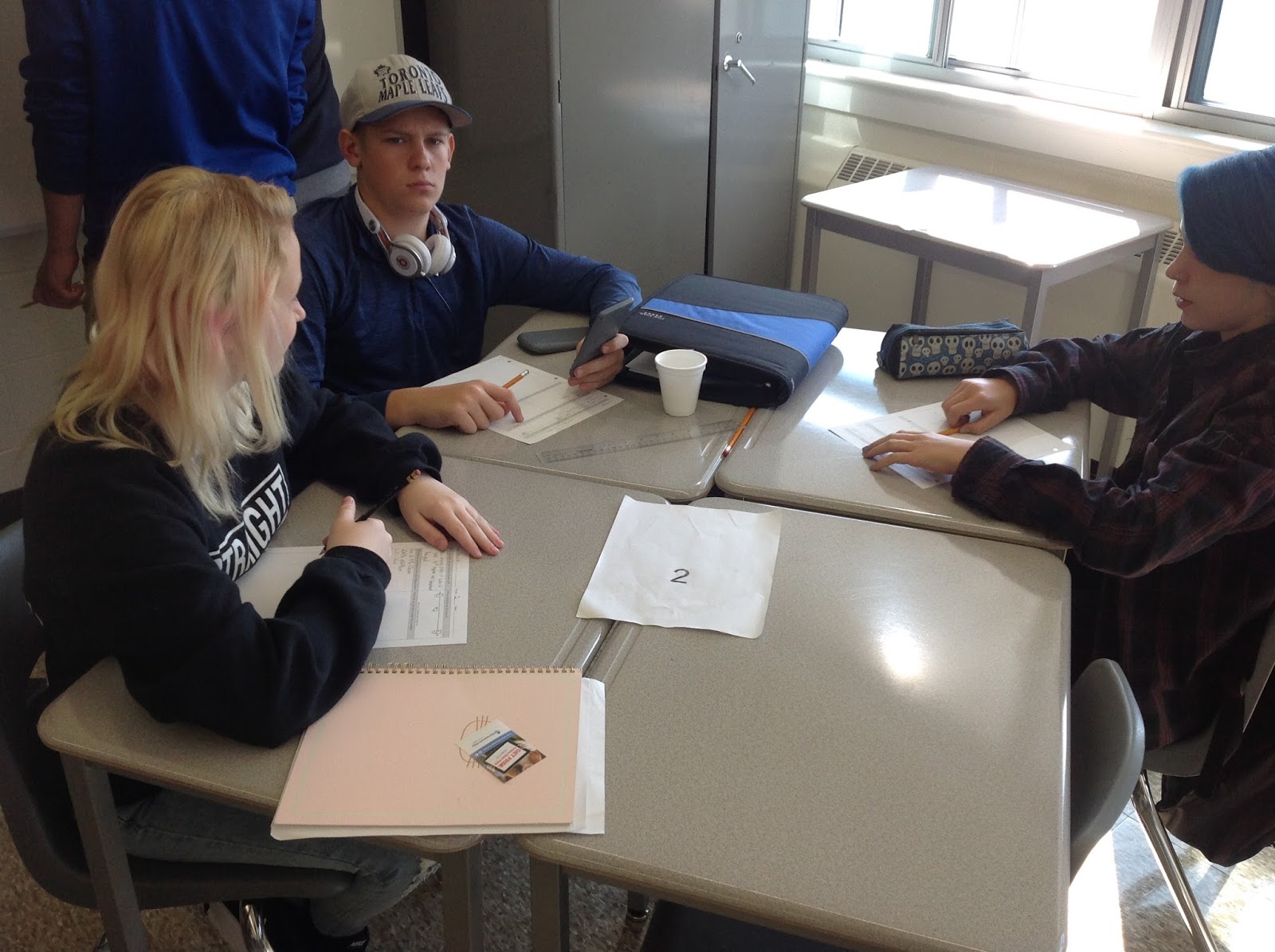
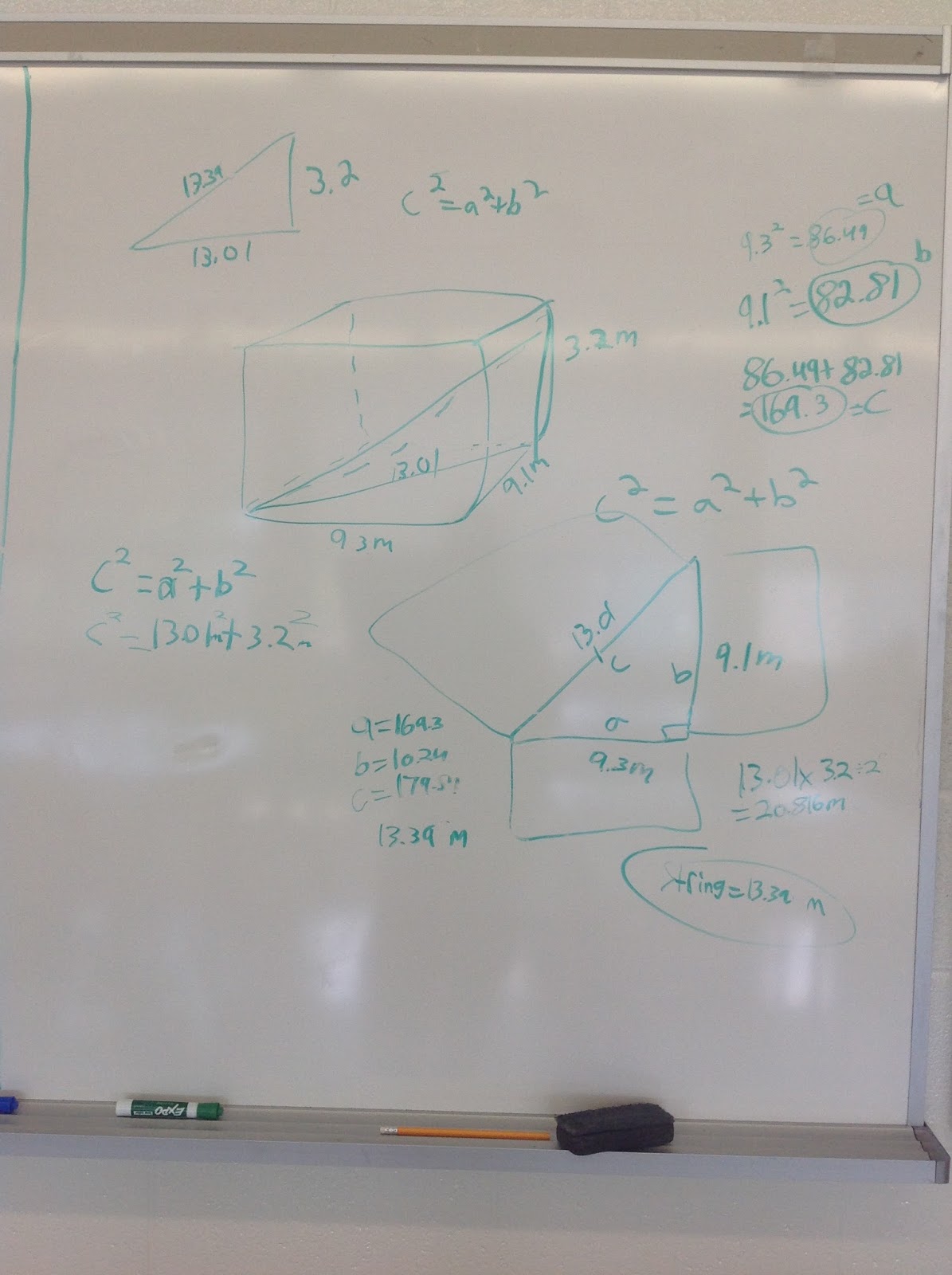
When I start with problem solving I like to use a problem solving framework. I really like Robert Kaplinsky's layout so I handed it out and we started filling it in together.We'll do it together the first couple of times, then they can do it on their own and eventually, hopefully, they won't need the framework anymore.  Once they had all the information they needed  I put them into random groups of 3 and sent them to the board to work.

It was interesting to watch. We aren't working on any particular unit now so I saw some interesting approaches. Some groups calculated volume, others talked about finding surface area. I asked a few questions about whether volume or surface area would be helpful. I asked them to remind me what they were looking for then let them try to sort things out.

 Some groups recognized that there were right triangles involved and made reference to the Pythagorean Theorem. I heard "I don't remember the Py...whatever theorem."

We were quickly running out of time so I handed out a page with some homework questions for adding and subtracting integers and the bell went.

Tomorrow we'll get back in our groups and continue trying to find the length of the string.

Tuesday, September 5, 2017

MPM1D1 - Day 1

This year I decided to change things up for the first day. I decided to skip all the regular first day stuff and dive right into the math. We can do the first day stuff some other day (I guess that doesn't make it first day stuff anymore though). I wanted my grade nine students to be doing math and enjoying themselves rather than being bored of listening to me.

We started with some Estimation 180. I had students guess a number that was too low, another that was too high and, finally, an actual guess. I like starting with this because everyone can pick a number. It's very low risk. I was pleasantly surprised at the too low and too high guesses. Nobody gave number that were crazy low or high. I gave students time to come up with their guesses. I took a bunch and wrote them on the board, which was a great way to get students participating. Once the list was on the board I went to move on when a student asked what the answer was. We had a look, then figured out what their percent errors were. They were all quite close.

After the estimating we moved onto a number talk. I asked students to figure out what 25*8 was without using a calculator. As I said it to the class it occurred to me that this was an easy one to relate to money so perhaps it would be too easy. Oh well. Next time I'll refer to my notes rather than working from memory. I had originally intended to ask 25*12. In any case, we had a few different methods that were shared. Nobody used an area model so I went over it and a couple of other methods. This was another fairly simple task that helped students build confidence.

Once we finished the number talk we moved onto Skyscrapers.


The idea is that you must have a tower of each height (1,2,3 and 4) in each row and each column and the numbers along the outside indicate the number of tower you can see from that location. It's very Sudoku like. I've seen a lot of people use this activity in the past, but I wasn't sure about it. It wasn't until I was at a session where teachers tried the activity that I realized what a great first day activity this could be. It involved problem solving, collaboration, attempting and failing then reattempting and lots of communication.

I was hoping to get to some integer addition and subtraction today as well, but I guess that will have to wait until tomorrow.

I had a great day and I hope my students did as well. I hope they had fun, felt comfortable and enjoyed themselves. We covered a fair bit of ground: estimation, percent, multiplication and problem solving.

I need to remind my self to take more pictures!